

Breeding birds: 16,000 pairs
Family: Grassbirds And Allies
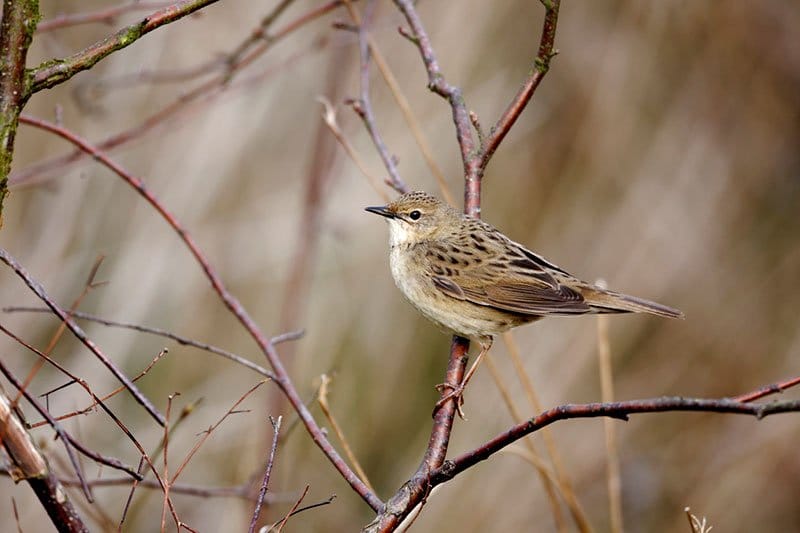
Grasshopper warblers have pale olive-brown upperparts with darker brown streaks. The underparts are cream or pale buff with some dark brown spots and streaks on the breast, and dark streaks on the vent. The wings are brown with paler edges to the feathers, and the tail is reddish-brown with streaks on the undertail coverts. Faint transverse bars are sometimes visible.
The head is olive-brown with grey cheeks, there is a dark line through the eye and white crescents above and below the eye. The eyes are brown, the bill is dark brown with a yellow lower mandible, and the legs and feet are pale yellowish-brown. Male and females are similar
Juvenile grasshopper warblers resemble the adults but show more streaking on the back and flanks, and they are lighter on the underparts.
Try our interactive bird identifier
Grasshopper warblers start breeding in late April and continue into early August. They usually produced two broods. Both male and female build the nest which is situated close to the ground and hidden in vegetation. It is made from grass, sedge, and moss, and lined with finer grass, hair, and sometimes feathers.
Grasshopper warblers lay 3-7 smooth, glossy white eggs with purple and brown speckles which are incubated by both parents for 12-15 days. Chicks fledge 12-13 days after hatching.
Grasshopper warblers eat almost exclusively insects including flies, dragonflies, moths, beetles, and aphids, as well as spiders and woodlice.
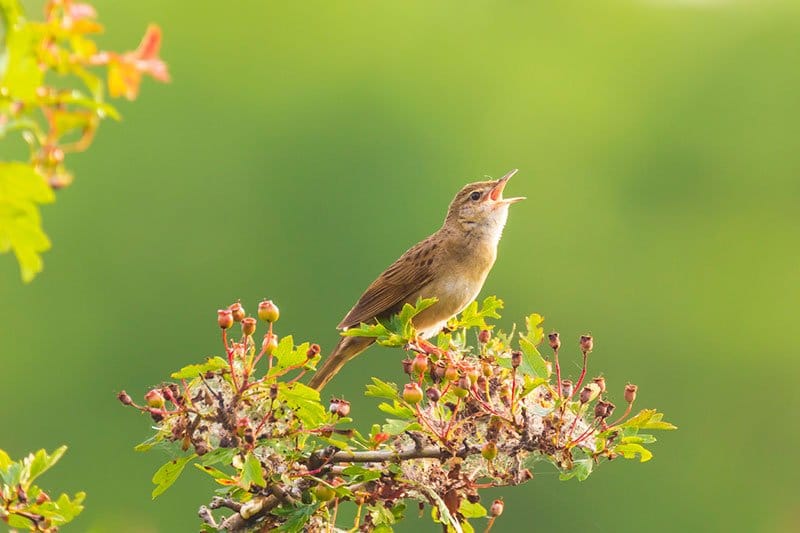
Grasshopper warblers arrive in the UK in April and leave in October. They are scattered across the UK although less common in Scotland. Look out for them in areas of thick scrub, grasses, reedbeds, forests, and gravel pits.
Britain's Birds
RSPB Handbook Of British Birds
Collins Bird Guide
The grasshopper warbler’s song, a monotonous, unmusical trill which gives the species its name, has a ventriloquism effect, so even if you hear it singing it can be hard to work out its exact location.


