


The starling is a gregarious bird, often seen in large, noisy flocks. During breeding season, its plumage is black with a glossy, iridescent sheen of purple and green. Outside of breeding season, its feathers develop white tips, giving it a speckled appearance.
As a sociable species, starlings thrive near humans and have adapted well to urban environments. They take advantage of the abundance of food and the cavities in buildings, which resemble the natural nesting sites they use in the wild. However, they can be aggressive, often chasing other birds from feeding areas and commandeering nesting sites.
Their adaptability has allowed them to quickly establish themselves in regions where they have been introduced. For example, in the late 19th century, 60 starlings were introduced to New York. Today, the population in the United States is estimated to exceed 200 million, all descended from those original birds. As a result, starlings are considered pests in some countries, prompting culling and eradication programmes.
Starlings are widespread throughout the UK. During autumn and winter, they gather in vast roosts, particularly in southern England, putting on spectacular aerial displays, known as murmurations.
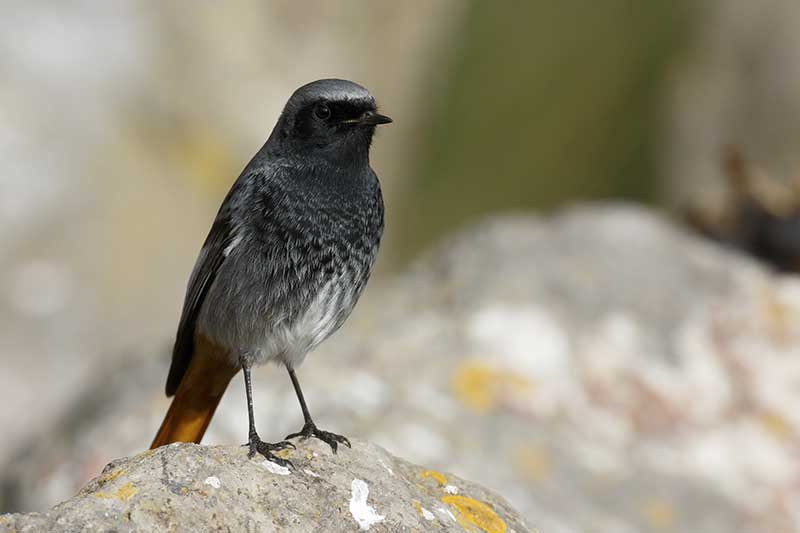
The black redstart is a rare breeding bird in the UK but is joined by wintering individuals between late autumn and early spring. It is sometimes known as the bombsite bird due to its population increasing after the bombed out buildings of World War II provided it with homes that mimicked its natural habitats.
The male is charcoal black with a white wing panel and rusty orange tail. The female is brown with a grey head and pale eye-ring. It has black legs which distinguishes it from a juvenile robin.
It stands upright and quivers its tail as it perches amongst vegetation or buildings and monuments, before dropping to feed on insects and berries on the ground. It has a sharp call and a far-carrying song which is a trill followed by a dry crackle.
During autumn passage and winter look out for black redstarts across the UK but particularly around rocky coasts. They can also turn up in industrial areas, railway stations, and cities.
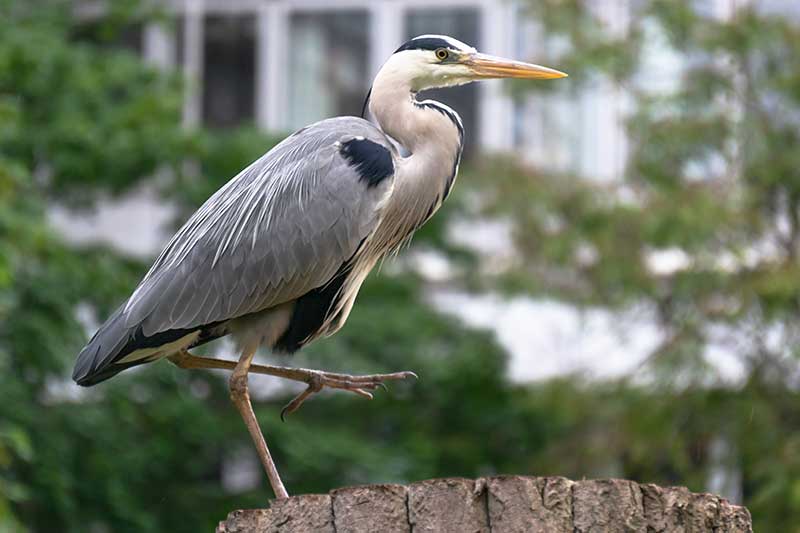
The grey heron is a tall, long-legged wading bird that can reach up to 1 metre in height. Its body is predominantly grey with black patches along the flanks. The head and neck are white, with a bold black stripe running through the eye that extends to long, drooping feathers on the back of the neck. It has a large, dagger-like orange bill, and grey, pink, or yellow legs.
Although naturally wetland birds, grey herons have adapted well to urban environments, and are known to raid garden ponds for ornamental fish. In Amsterdam there is a thriving population, where they scavenge food from markets, street vendors, and rubbish dumps.
In urban areas, they can be spotted near water sources such as ponds, lakes, canals, and even zoo enclosures, where they have been observed stealing fish intended for penguins, pelicans, and seals. Herons sometimes build their nests in urban parks, forming colonies known as heronries in tall trees.
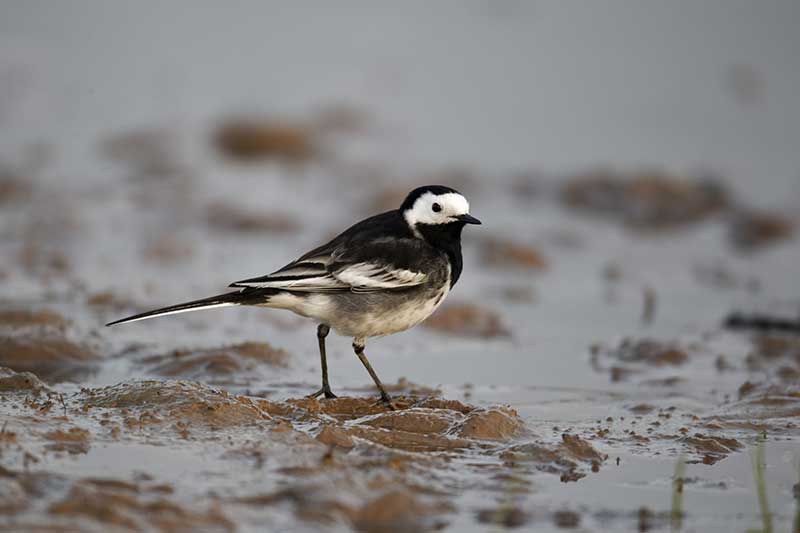
The pied wagtail is a small, black and white bird with a grey and white face, a black crown, and a distinctive black bib. In the UK and Ireland, it is a subspecies of the white wagtail (Motacilla alba), and has a darker back than the nominate race.
It is a common sight in urban areas, often seen darting across car parks, playing fields, shopping centres, and petrol stations. It is easily recognised by its habit of rapidly bobbing its tail up and down as it searches for insects, seeds, and discarded food.
In winter, pied wagtails gather in large roosts, sometimes numbering hundreds of birds, in trees and bushes in parks and along avenues. They have also been known to roost in unusual places such as the cooling towers of power stations, sewage works, factory roofs, supermarkets, heated greenhouses, and near hospitals.
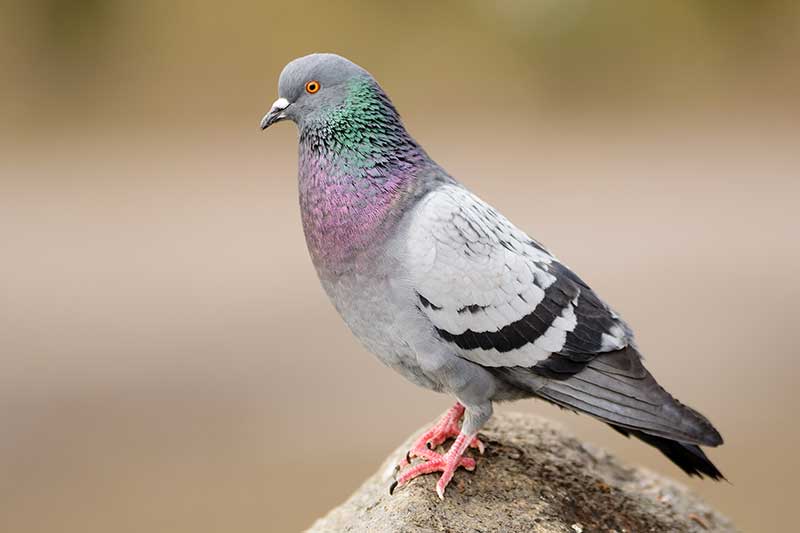
The feral pigeon, also known as the city pigeon or street pigeon, is descended from domestic pigeons originally bred from the wild rock dove. While they share the same shape and size as their wild ancestor, feral pigeons display a much broader range of plumage patterns and colours. Their feathers tend to be darker, with less of the characteristic blue, purple, and green iridescence of rock doves. Some have lost these colours entirely and may appear in shades of white and brown.
Feral pigeons have adapted remarkably well to urban environments. Tall buildings replicate the cliff faces that serve as their natural nesting sites, and their varied diet, combined with a rapid breeding rate, has enabled their population to grow rapidly. However, their abundance and behaviours have led to them being viewed as pests, earning them the nickname “flying rats” due to their scruffy appearance, habit of eating rubbish, prolific droppings, and potential to spread disease.
Pigeons are often seen in large flocks, particularly around tourist attractions, where they wait for scraps of dropped food. Feeding pigeons has been a popular pastime in London since the 1800s, with some people even making a living selling birdseed in Trafalgar Square. Tourists would visit specifically to feed the birds, but the increased availability of food led to a surge in pigeon numbers, creating a nuisance and posing health risks. In 2003, the Mayor of London banned pigeon feeding in Trafalgar Square, introducing fines for those who continued the practice.
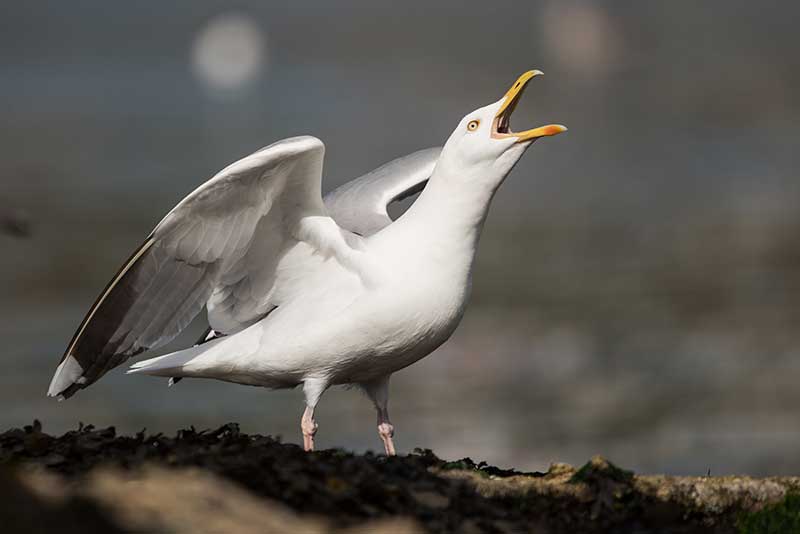
The herring gull is a large, noisy bird, with a reputation for stealing chips and aggressive behaviour. In breeding plumage, it has a pale grey back, white underparts, and black-tipped wings. Its head is pure white, and its yellow beak is marked by a distinctive red spot underneath. Outside of breeding season, its head develops grey streaks, and its beak becomes duller in colour.
Although traditionally associated with coastal areas, the noisy squawks of herring gulls are now more likely to be heard in inland towns and cities.
Herring gulls breed on the roofs of tall buildings, which provide a safe place from predators such as foxes and seals, as well as great black-backed gulls, which preys on their eggs and chicks. Highly opportunistic feeders, they scavenge discarded food in streets, rubbish dumps, and landfills, and due to street lighting, can even forage at night. Over time, they have become increasingly bold around humans, frequently snatching food from people’s hands or “shoplifting” from supermarket shelves.
Despite all this, the herring gull population has declined significantly, leading to its placement on the Red List of Birds of Conservation Concern in 2009. As a result, killing herring gulls is now only permitted under a special licence in specific circumstances, whereas it was previously allowed under a general licence issued to landowners or occupiers.
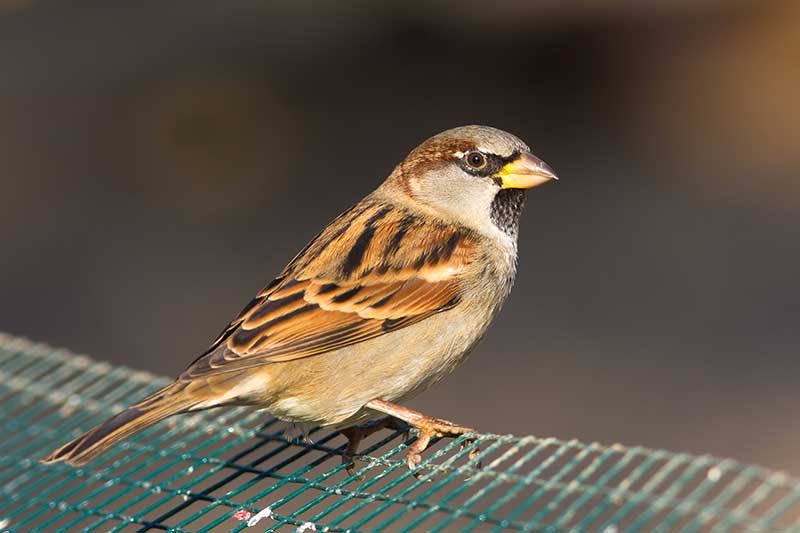
The house sparrow is a small, lively bird that was once so common in London it earned the nickname the “Cockney Sparrow.” The male has a black and brown streaked back, grey underparts, and chestnut wings with white wingbars. Its face is white with a black bib and a grey crown. In contrast, the female is has subdued grey-brown plumage overall.
House sparrows are highly adaptable and opportunistic feeders, eating a wide variety of foods including seeds, fruits, grains, nuts, and discarded scraps. They are also frequent visitors to bird tables and feeders.
For centuries, house sparrows have lived alongside humans, evolving to nest in the cavities of farm buildings and taking advantage of the food available on farms. In the 18th century, their numbers were so high that Sparrow Clubs were established in Britain with the goal of culling as many as possible.
The growth of urban areas provided an even greater abundance of food and nesting opportunities, prompting house sparrows to migrate from rural villages to towns and cities. However, over the last fifty years, their population has declined sharply, and it is now rare to see the large flocks that were once a common sight.

The carrion crow is a large black bird with a glossy green sheen on its head and a purple sheen on its body. It has long been linked to myths and superstitions.
Originally a bird of farmland and grassland, the carrion crow is now a familiar sight in towns and cities. Like all corvids, it is highly intelligent and remarkably adaptable. Its diet is extremely varied, including insects, seeds, fruit, berries, nuts, small mammals, birds, eggs, and, as its name suggests, carrion. Their problem-solving skills enable them to access food in discarded packaging, such as takeaway boxes or crisp packets commonly found in urban areas.
It has been suggested that crows are capable of passing on information about threats to their peers and offspring. They appear to have learned that towns and cities offer greater safety compared to the countryside, where they have historically been persecuted as pests, such as being blamed for killing newborn livestock.
With access to artificial nesting sites and low levels of natural predators, carrion crows have thrived in urban environments with studies showing that urbanisation has had a positive impact on their populations.
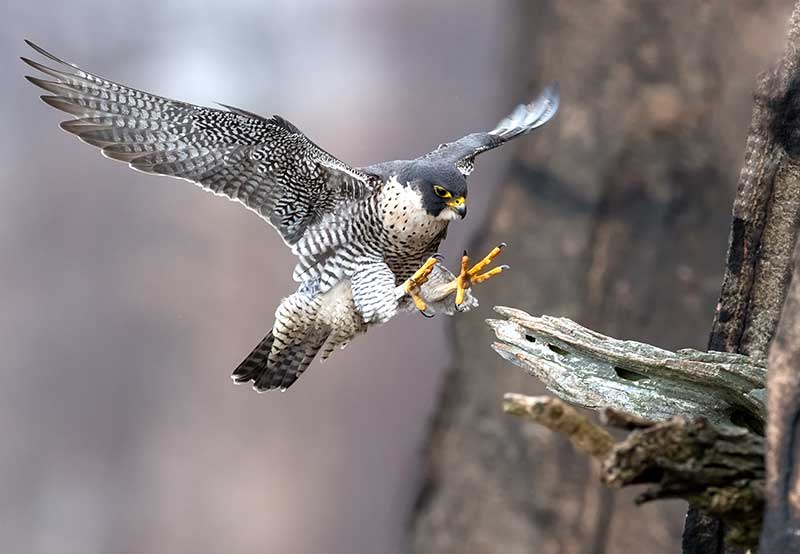
The peregrine falcon is the UK’s largest falcon and is famous for being the fastest bird in the world.
It has a slate-grey back, white barred underparts, and a black head. While both sexes have similar plumage, the female, as with most bird-eating raptors, is significantly larger than the male.
Historically, peregrine falcons were confined to the north and west of the UK, nesting on inland and coastal cliffs. Their population suffered a severe decline in the 1960s due to the loss of habitat, but thanks to dedicated conservation efforts, their numbers have steadily recovered, and the species is now making a good comeback.
In recent years, peregrine falcons have adapted to urban environments, where they thrive due to the abundance of feral pigeons that make up much of their diet. Artificial lighting in cities also allows them to hunt beyond dusk, preying on nocturnal migrants such as redwings, fieldfares, and starlings.
Peregrine falcons are known for nesting in unconventional locations, including the window ledges of skyscrapers and tower blocks, cathedrals, and suspension bridges. Many of these sites are equipped with webcams, enabling people to watch them as they build nests, incubate eggs, and rear their chicks. Notable live webcam locations include Derby Cathedral, Norwich Cathedral, Winchester Cathedral, and Leicester Cathedral.
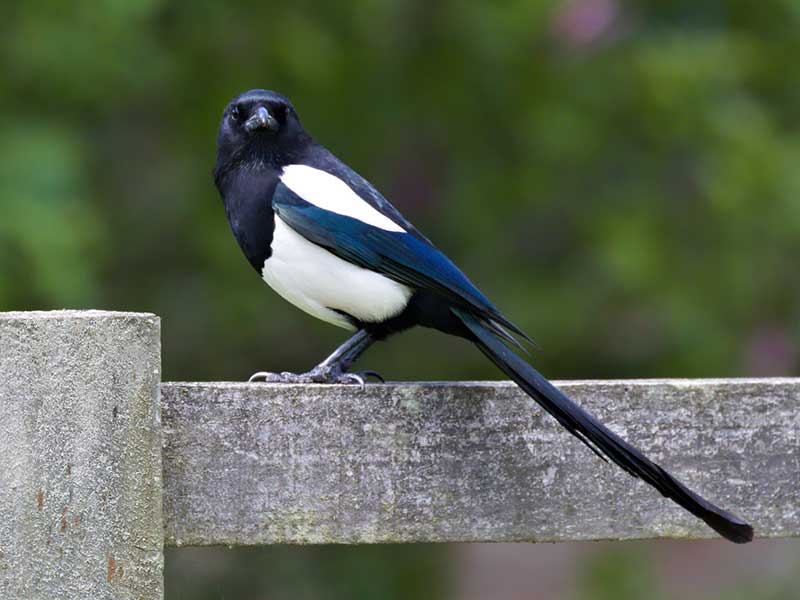
Like the carrion crow, the magpie is a member of the corvid family and is also associated with various superstition. Bold and inquisitive by nature, it is an unmistakable bird with striking black-and-white plumage, a long tail, and iridescent blue-green patches on its wings.
Magpies were once common across the UK, but their numbers plummeted from the mid-19th century due to widespread persecution by gamekeepers, who sought to eradicate them because of their appetite for eggs and chicks, a campaign that continued until the First World War. While shooting magpies is still permitted on many country estates, the intensity of persecution has decreased, and their population has since recovered.
Magpies have also thrived in urban and suburban areas, with populations in towns and cities growing faster than those in rural regions. Their intelligence and adaptability have been key to their success, showing remarkable resourcefulness. They have even been observed using anti-bird spikes to construct their nests.
Urban environments provide an abundance of food and shelter, as well as protection from natural predators. The warmth of buildings has further contributed to their success, allowing magpies to begin breeding earlier in the year, which has improved chick survival rates.
Find out more


